

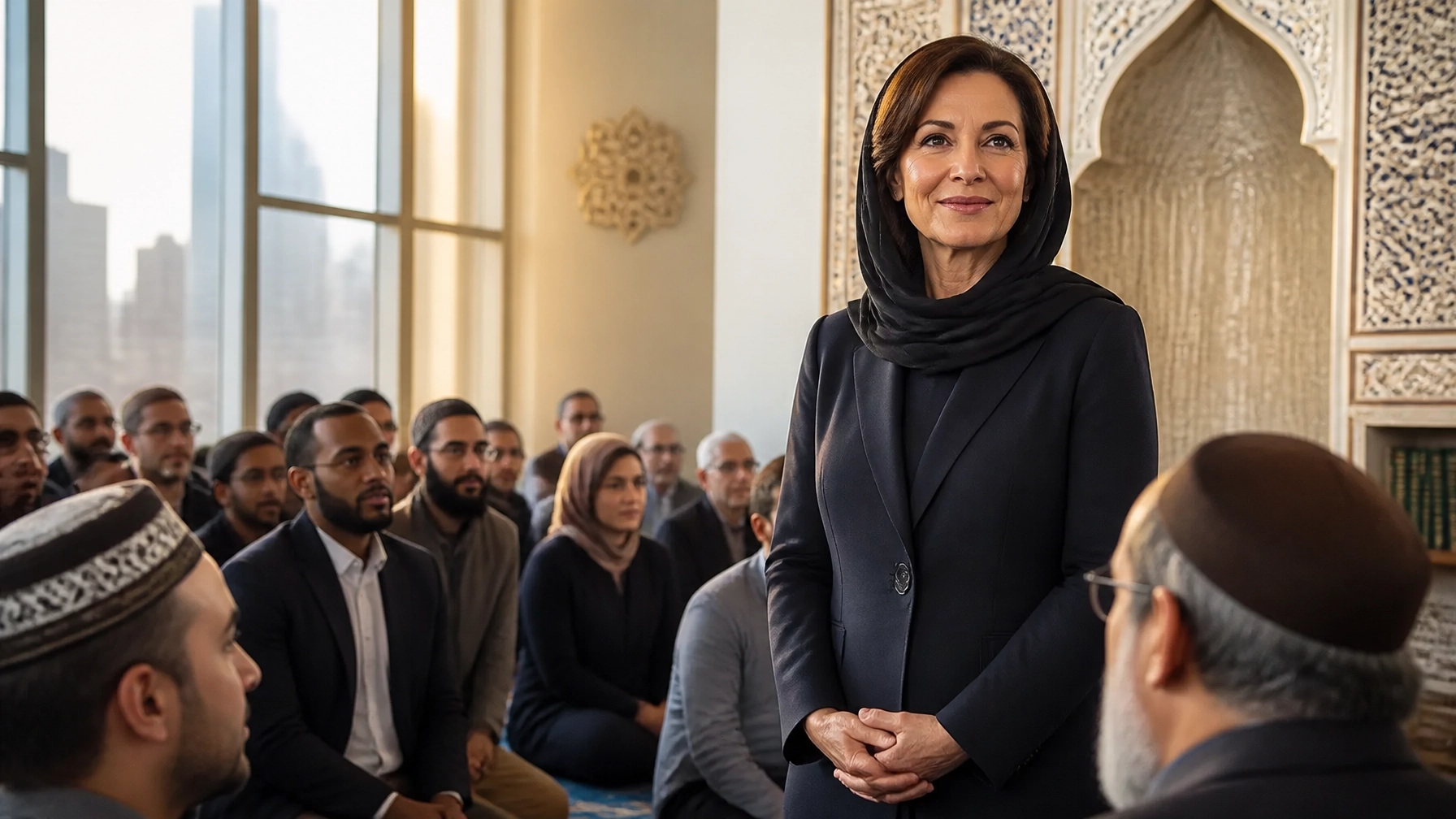
New York Gov. Kathy Hochul escalated her response Thursday to Nassau County Executive Bruce Blakeman’s attacks over her mosque visit, calling his effort to portray her religious gesture as political theater “reprehensible” and accusing him of trying to divide New Yorkers by faith.
The dispute has become one of the most heated exchanges in the 2026 New York governor’s race, placing religious expression, campaign strategy and the approaching 25th anniversary of the Sept. 11 terrorist attacks at the center of state politics.
Hochul condemns Blakeman’s rhetoric
Hochul’s latest remarks followed days of criticism from Blakeman, the Republican nominee challenging her in November. In a social media post, Blakeman labeled the governor “Hijab Hochul” and described her head covering as her “latest costume,” writing that she would become “whoever she needs to become when there are votes on the line.”
Hochul said the attack crossed a political line.
“To attempt to divide New Yorkers based on their faith is reprehensible,” she said, according to reporting on Thursday’s exchange.
The governor also defended the decision that triggered the controversy, saying she was visiting the Islamic Cultural Center of New York as a guest and wore appropriate attire inside the prayer hall.
“I was invited as a guest, and I always wear the appropriate attire, whether I am going to a temple, whether I am going to an Orthodox community or whether I am going to a Catholic church in the Vatican,” Hochul said in remarks reported by ABC7NY.
She added that Blakeman’s objection reflected more on him than on the governor or the Muslim community.
What Blakeman said about the mosque visit
The controversy began after Hochul visited the Islamic Cultural Center on Manhattan’s Upper East Side on Aug. 28. She toured community spaces and the affiliated school before addressing worshippers in the prayer hall during Friday prayers.
Video and photographs from the visit show Hochul wearing a black headscarf while speaking inside the religious space. Her hair remained partly visible, and she later appeared without the covering while touring the school.
A Snopes fact-check concluded that the footage was authentic but distinguished between a headscarf and a traditional hijab. The fact-check noted that Hochul covered her head as a gesture of respect during the mosque visit but was not wearing a traditional hijab as the term is commonly understood by many Muslim women.
Blakeman’s post characterized the covering as a campaign costume rather than an act of religious courtesy. He also argued that the timing was inappropriate, coming less than two weeks before the 25th anniversary of the Sept. 11 attacks.
“Less than two weeks before the 25th anniversary of 9/11, this kind of political pandering is especially tone-deaf,” Blakeman wrote, according to Newsday. “New Yorkers deserve a Governor with principles that don’t change depending on the audience.”
In a subsequent interview, Blakeman said Hochul’s decision to wear the head covering did not align with her identification as a feminist. He described the two positions as incompatible, intensifying criticism from Muslim leaders and Hochul’s campaign.
Blakeman later rejected accusations that he was attacking Muslims. He pointed to his visits to mosques and his appointment of Nassau County’s first Muslim police chaplain in 2023 as evidence of his engagement with the community.
Muslim and Jewish leaders object
Muslim leaders in Nassau County condemned Blakeman’s language and demanded an apology. They said describing a religious veil as a “costume” reduced a significant religious practice to a political prop and reinforced stereotypes that Muslim Americans have faced for decades.
Abdul Aziz Bhuiyan, chairman of the Hillside Islamic Center and an adviser to the Muslim Community of Nassau County, said the post was unbecoming of a candidate seeking statewide office.
Kevin Shakil, president of America’s Muslim Network, told Newsday that connecting Hochul’s headscarf to Sept. 11 reinforced a stereotype Muslim Americans had spent 25 years challenging.
Afaf Nasher, executive director of the Council on American-Islamic Relations New York, said covering one’s head inside a house of worship was a sign of respect and should not be treated as evidence of political manipulation.
“The essence of equal rights is making the choice to wear a hijab or not,” Nasher said, according to ABC7NY. “So, him attacking her choice to wear a hijab and Muslim women’s choice to wear a hijab is actually what is disempowering and anti-feminist.”
The criticism also came from Jewish communal leaders. Amy Spitalnick, chief executive of the Jewish Council for Public Affairs, accused Blakeman of helping to normalize Islamophobia by invoking the Sept. 11 anniversary in connection with Hochul’s religious attire.
“There are far too many political leaders exploiting the 9/11 anniversary to (re)normalize Islamophobia : and it’s disgusting,” Spitalnick wrote in a statement cited by the Jewish Telegraphic Agency.

Hochul points to a broader record of religious respect
Hochul’s campaign said the mosque visit was consistent with her practice of observing religious customs when entering houses of worship.
Her office cited previous occasions when she covered her head at Muslim events, including a 2022 visit to a Long Island mosque that had been attacked and the funeral of NYPD Officer Didarul Islam in 2025.
Hochul also publicly supported Muslim women’s freedom to choose whether to wear the hijab on World Hijab Day in 2024. The governor’s campaign argued that the latest visit should be understood within that broader record rather than as an isolated campaign appearance.
“Whether she’s at a church, a synagogue, or a mosque, Governor Hochul respects all New Yorkers’ faiths,” campaign spokeswoman Sarafina Chitika told Newsday. “And she leads with that respect rather than fanning the flames of division.”
The governor’s response has focused on the distinction between participating in a religious custom as a visitor and adopting a religious identity for political purposes. Hochul said she was not presenting herself as Muslim but following the expectations of the space she had entered.
That distinction has shaped the public debate over the episode. Supporters see the head covering as ordinary interfaith courtesy, while Blakeman and conservative commentators have presented it as evidence of political calculation.
The 9/11 anniversary becomes a campaign fault line
The timing of the dispute has given both campaigns a powerful political frame.
Blakeman has argued that Hochul’s visit and head covering were insensitive because they occurred shortly before the 25th anniversary of the Sept. 11 attacks. His criticism follows a broader conservative narrative portraying Hochul as too willing to accommodate Muslim constituencies.
President Donald Trump also amplified the controversy by criticizing Hochul and accusing her of seeking the “Arab vote,” further moving the dispute from a New York gubernatorial contest into the national political conversation.
Hochul and Muslim community leaders have rejected the premise that honoring Muslim religious customs conflicts with remembering the attacks. They said the anniversary should reinforce opposition to violence and discrimination rather than associate ordinary Muslim practices with terrorism.
Alan Mindel, chairman of the Holocaust Memorial and Tolerance Center, said there was nothing improper about wearing a hijab or another religious covering. He argued that the central lesson of Sept. 11 should be opposition to hatred directed at any community.

A test for New York’s political tone
The clash arrives as Hochul and Blakeman prepare for a high-stakes statewide campaign shaped by affordability, housing, public safety and immigration. Recent polling has shown Hochul maintaining an advantage while Blakeman works to increase his visibility beyond Nassau County.
The campaign has already featured sharp disagreements over immigration enforcement, the city-state relationship and Democratic leadership. Blakeman’s decision to make Hochul’s mosque attire a central attack adds religious identity and cultural conflict to the race.
For Hochul, the response provides an opportunity to present herself as a governor defending religious freedom and New York’s diversity. For Blakeman, the criticism reflects an effort to portray Hochul as politically inconsistent and disconnected from voters concerned about terrorism and public safety.
The exchange also carries particular weight in Nassau County, where Muslim communities have grown significantly over the past two decades. Newsday reported that Muslims accounted for about 3.5% of the county’s population in 2020, with more than 48,000 residents recorded in available data.
As the campaign advances, both candidates will face pressure to explain whether the dispute represents a broader vision for New York or simply another volatile episode in an increasingly nationalized race.
Hochul has made her position clear: she will not apologize for showing respect inside a house of worship, and she says attacks that turn religious observance into a political weapon are unacceptable.
In a state defined by religious diversity, the confrontation has become a defining question in New York politics: whether cultural and faith-based gestures should be treated as evidence of inclusion or ammunition for partisan attack.
For more coverage of state leadership and New York development, read New York News Daily’s report on Hochul’s $200 million downtown Albany investment and visit the New York News Daily homepage.