

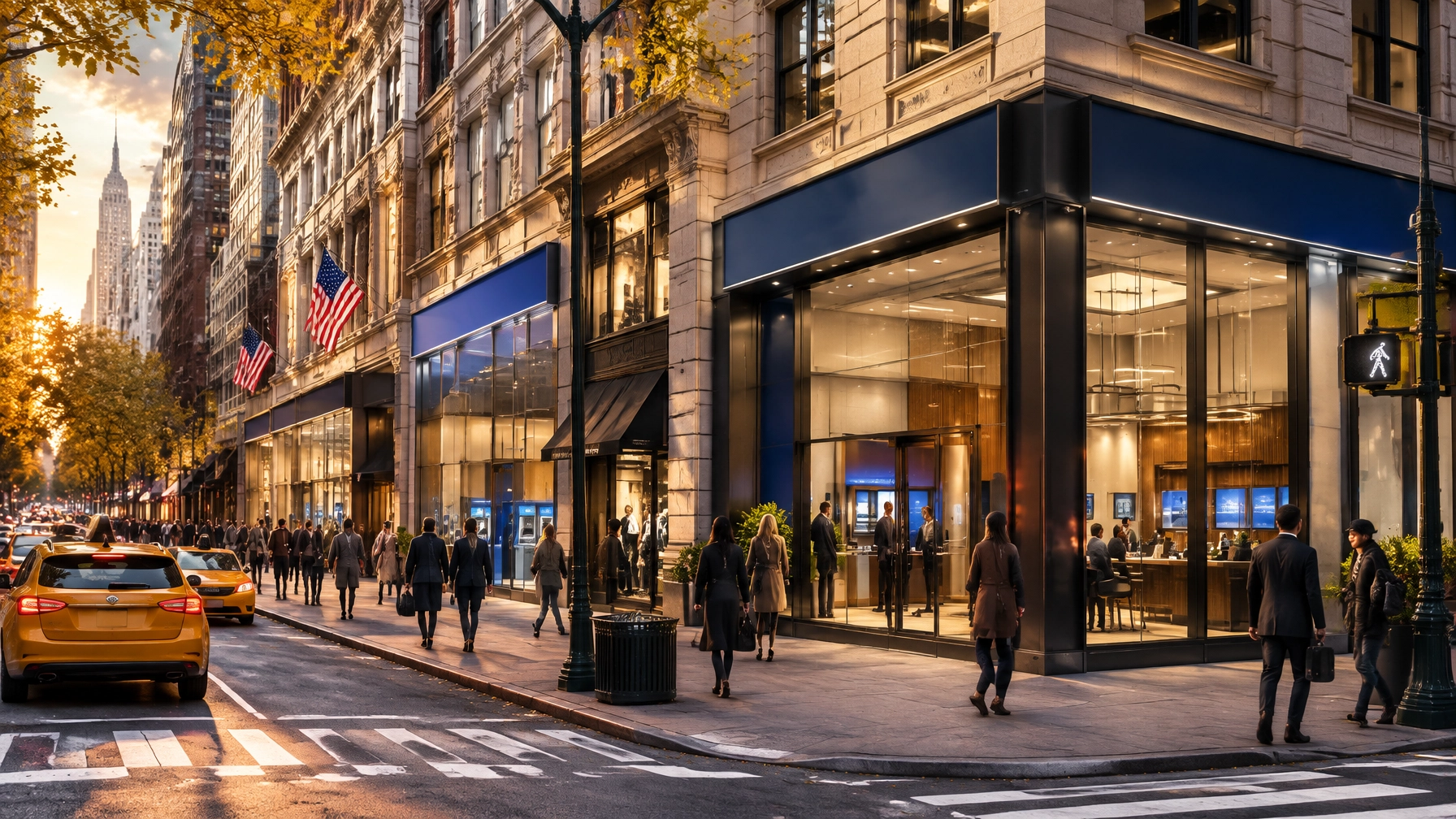
Manhattan’s prime retail market has tightened to its lowest availability level since tracking began in 2017, as bank branches and financial institutions claim high-visibility storefronts across the borough and push rents higher for remaining space.
Q3 2026 market data shows availability falling to 11.4% across leading Manhattan retail corridors, with only 157 spaces still open-38 fewer than a year earlier. Average asking rents reached approximately $605 per square foot, a 5.7% increase from the same period last year.
The figures capture a major shift in the borough’s street-level economy: Manhattan is no longer defined by large numbers of vacant storefronts, but by intense competition for a shrinking supply of well-located retail space.
Bank branches become major retail tenants
Banks have emerged as some of the most active occupants of prime storefronts. Bank of America leased approximately 16,309 square feet at 19 Union Square West, while OceanFirst committed to roughly 4,100 square feet at 36 Union Square East. Citibank also took approximately 14,274 square feet at 170 West 72nd Street.
Together, those transactions represent nearly 35,000 square feet of prime street-level space, with additional financial-institution deals reportedly moving through the market.

The expansion is significant because bank branches typically seek locations that other retailers also value: corners, major avenues, transportation hubs and blocks with steady pedestrian traffic. Their storefronts often require generous frontage, prominent signage, customer-accessible interiors and long lease commitments.
Those requirements allow banks to compete directly with fashion retailers, restaurants, specialty shops and neighborhood services for the same limited inventory.
The trend also reflects a broader rebalancing of commercial real estate. Financial institutions are not simply filling leftover spaces. They are securing highly visible locations that can strengthen brand recognition, support customer service and connect digital banking platforms with physical offices.
Why banks are expanding their physical footprints
The growth of online banking has not eliminated the value of branches. Instead, banks are redesigning their physical locations around a smaller number of higher-impact sites.
A modern branch may offer fewer traditional teller windows and more private meeting rooms for mortgages, business loans, wealth management and financial planning. Prime Manhattan addresses can help banks reach affluent consumers, corporate clients, entrepreneurs and international customers in a single market.
Physical branches also provide visibility that digital advertising cannot fully replicate. A prominent storefront places a financial institution directly along the daily routes of workers, residents, visitors and business owners. The location becomes a permanent form of advertising while also serving as an operating office.
Banks may also be responding to increased demand for in-person assistance with complex financial decisions. Commercial lending, real estate financing, private banking and wealth management often require personal meetings, particularly in a market where transactions involve substantial sums and complicated documentation.
For landlords, a bank can be an attractive tenant because of its credit profile, operational stability and willingness to commit to a long lease. Those qualities can make financial institutions competitive even when their use of the space generates less frequent customer traffic than a restaurant or popular retailer.
Tight supply gives landlords greater leverage
The decline in availability has strengthened landlords’ negotiating position, particularly along the borough’s best-known corridors.
SoHo recorded availability of about 7.4%, a record low for the district. Union Square and Flatiron reached approximately 10.1%, matching a prior record. Lower Fifth Avenue, Times Square and 34th Street-Herald Square also experienced declines in available space.
With fewer vacancies, landlords have more room to demand higher rents, stronger financial guarantees and longer lease terms. They can also become more selective about tenant quality, use restrictions and the type of business entering a building.
Prime retail owners may now have less incentive to offer substantial concessions, including free-rent periods, large construction allowances or flexible termination provisions. Tenants that once had leverage during the post-pandemic recovery are increasingly competing against one another for a limited number of move-in-ready locations.
The result is a market divided by geography and quality. A well-positioned storefront near a transit station or established shopping corridor may command strong pricing, while a less visible space on a side street can remain difficult to lease despite the broader improvement.
Another measure of Manhattan rents in 2026 uses a broader basket of properties and places average asking rent closer to $710 per square foot. The difference reflects the way market reports define their coverage, but both measures point to the same conclusion: prime retail space is becoming more expensive and harder to secure.
Small retailers face a sharper cost test
For independent retailers, the shrinking supply creates both opportunity and risk.
The positive side is increased foot traffic and stronger demand for neighborhood services. A full storefront lineup can make a block feel safer, more active and more attractive to consumers. Small businesses may benefit from the presence of major banks if employees and customers spend money at nearby cafés, pharmacies, restaurants and specialty shops.

The pressure comes from occupancy costs. Higher asking rents can force small retailers to commit more capital before opening, leaving less money for staffing, inventory, marketing and renovations. Businesses with narrow profit margins may struggle to absorb a rent increase when insurance, wages, utilities and wholesale costs are also rising.
Some operators may respond by choosing smaller spaces, sharing retail frontage, moving to secondary corridors or negotiating shorter initial commitments. Others may prioritize flexible concepts such as appointment-based services, showroom formats and compact food or beverage operations.
Retailers that already hold leases could gain an advantage if they locked in favorable terms before the latest rent increases. Their challenge will be determining whether to renew at a higher rate or relocate before the next lease cycle.
What the shift means for Manhattan’s street-level economy
The arrival of banks can contribute stability to commercial corridors, but it does not automatically replace the economic activity generated by every type of retailer.
A bank branch may attract customers during business hours, but it generally does not produce the same evening traffic as a restaurant, entertainment venue or destination shop. Its storefront may also contain less merchandise and fewer public-facing displays than a traditional retailer.
That difference matters for the character of a neighborhood. A corridor with a healthy mix of banks, restaurants, services, cultural venues and independent stores can remain active throughout the day. A corridor dominated by financial offices may look polished and well-maintained but become quieter after working hours.
Landlords and local officials therefore face a balancing challenge. Financial institutions can fill vacant spaces, bring stable tenancy and signal confidence in a neighborhood. At the same time, an excessive concentration of similar uses can reduce retail variety and limit opportunities for smaller businesses.
The strongest corridors are likely to be those where bank branches function as anchors rather than replacements for a diverse commercial ecosystem.
A defining trend in NYC real estate
The Manhattan retail market’s record-low availability is one of the clearest current indicators of changing NYC real estate trends. The borough’s commercial recovery is no longer primarily about bringing tenants back to empty storefronts. It is increasingly about deciding which businesses can afford the limited space that remains.
Banks are helping drive that transition by competing aggressively for locations with visibility, access and long-term value. Their expansion reflects confidence in Manhattan’s customer base and the continuing importance of physical locations for financial services.
For landlords, the market offers stronger pricing power and a deeper pool of creditworthy tenants. For small retailers, it creates a more demanding search for space and a greater need for careful financial planning. For residents and visitors, it could produce busier, more valuable commercial corridors, but only if the mix of tenants remains broad enough to sustain activity beyond traditional banking hours.
The latest New York real estate news points to a market where prime storefronts are no longer waiting for tenants; tenants are competing to secure them. Readers following commercial development, neighborhood change and Manhattan business news can find broader local coverage on the New York News Daily homepage.