

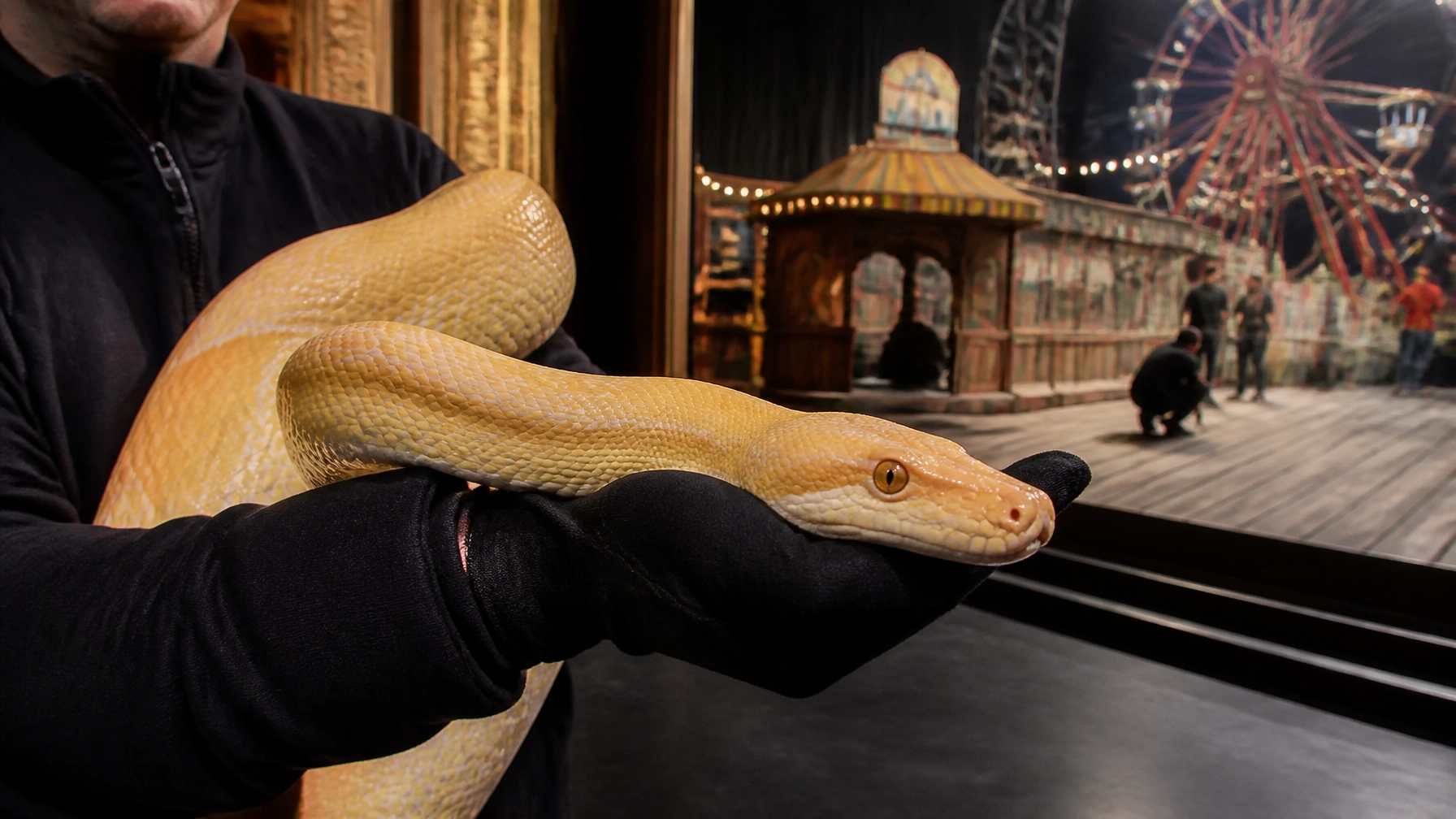
Princess, a large sun-glow boa constrictor with yellow-peach coloring, has won a high-stakes audition for a live snake role in the Metropolitan Opera’s 1950s Coney Island staging of Mozart’s Così fan tutte and will enter rehearsals on a trial basis this month.
The unusual casting decision places a reptile at the center of one of New York’s most talked-about arts stories as the Met prepares to revive its colorful carnival production for the 2026–27 season. The production is scheduled to open its September run at Lincoln Center, with performances listed for Sept. 23, Sept. 26 and Sept. 30, among additional October dates.
The audition was not a publicity stunt or a symbolic exercise. Princess had to demonstrate that she could remain calm, move safely and create a strong visual presence under theatrical conditions.
A snake audition for a Coney Island opera
The Met’s production, directed by Phelim McDermott, shifts Mozart’s 1790 comic opera from its original setting in Naples to a stylized 1950s Coney Island amusement park.
The staging surrounds the opera’s romantic deceptions with carnival attractions, sideshow performers and the visual language of the boardwalk. A Ferris wheel, roller-coaster imagery, brightly lit booths and theatrical curiosities create a world where spectacle is part of everyday life.
That setting provides a natural place for a snake charmer, a character performed by Zoe Ziegfeld. The live animal is not being added to the production as a random novelty; it belongs to the larger sideshow environment that shapes the staging’s tone and movement.
The Met previously presented the production in 2018, and it has returned to the repertory in later seasons. The staging has been presented as a colorful interpretation of Mozart’s opera, with the lovers’ complicated scheme unfolding amid the attractions of a Coney Island-inspired boardwalk.
Why Princess won the role
Ziegfeld auditioned several snakes for the part by working with them in conditions designed to resemble the demands of the performance.
The tests included allowing the snakes to move across the handler’s body, coil around the arms and tolerate being lifted overhead. Those actions mirror the visual business expected during the show, when the snake will be handled in front of a large audience beneath bright stage lighting.
Princess stood out for two reasons: size and color.
Her yellow-peach appearance gives her a pronounced stage presence, while her larger body makes her easier for audiences to see from a distance inside the Metropolitan Opera House. In a production built around bold visual images, a snake that can register clearly from the back of the auditorium is an important practical consideration.
Her selection also reflects a basic principle of live performance: the right performer must be able to repeat the same action safely and calmly, night after night.

An AI-generated editorial reconstruction of a snake audition; it is not a documentary photograph of the Met rehearsal.
The trial is about the handler, too
Princess will move into rehearsals on a trial basis, but the evaluation is not simply a test of the snake.
Ziegfeld has indicated that the physical challenge also belongs to the handler. A large boa constrictor can be difficult to lift repeatedly, particularly while maintaining stage posture, timing movement with singers and remaining aware of set pieces, lighting cues and audience sightlines.
The rehearsal period will allow the production team to determine whether Princess and Ziegfeld can work together consistently in the full theatrical environment. The process may include adjusting the choreography, changing the timing of the snake’s appearance or refining how the animal is transported and handled backstage.
A slightly smaller brown boa constrictor named Nala has been selected as Princess’s understudy. The backup arrangement gives the production an alternative if Princess is unavailable or if the creative team determines that a different animal is better suited to a particular performance condition.
The use of an understudy is familiar in opera, where principal singers, conductors and instrumentalists routinely have alternates. Applying that structure to a live animal underscores the operational complexity of the production.
From Mozart’s comedy to a carnival sideshow
Così fan tutte follows two young men who test the loyalty of their fiancées after being encouraged by the cynical Don Alfonso. The men disguise themselves and attempt to make each other’s partners fall in love with them, setting off a chain of comic deceptions that eventually exposes the instability of their assumptions.
McDermott’s production uses the Coney Island world to amplify the opera’s themes of performance, disguise and illusion. The characters are not simply moving through a realistic neighborhood; they are operating inside a theatrical universe where identities can shift and public entertainment blurs with private behavior.
The snake charmer fits that framework. The act adds another layer of spectacle while reinforcing the production’s interest in performers who live by carefully controlled displays of risk.
The result is a staging that treats the amusement park as more than a backdrop. It becomes a visual counterpart to the opera’s emotional games, with the bright lights and carnival attractions contrasting with the characters’ uncertainty and manipulation.

An AI-generated editorial reconstruction of the Coney Island-inspired stage environment.
What audiences should expect
Audience members should expect Princess’s appearance to function as part of the production’s broader sideshow sequence rather than as a separate animal act.
The snake’s precise stage time and handling routine may continue to evolve during rehearsals. Live-animal performances require flexibility, and the final presentation can depend on factors ranging from the animal’s behavior to the temperature and activity level backstage.
The production’s wider cast includes Federica Lombardi as Fiordiligi, Samantha Hankey as Dorabella, Duke Kim as Ferrando and Andrey Zhilikhovsky as Guglielmo. The revival also features the return of McDermott’s established visual concept, allowing audiences to see how the singers’ performances interact with the elaborate boardwalk setting.
The Met has also listed an Oct. 3 performance for its Live in HD cinema broadcast series, potentially giving viewers beyond New York a closer look at the production’s carnival design and its unusual reptilian cast member.
For New Yorkers tracking the city’s cultural calendar, Princess’s casting offers a particularly distinctive example of how major institutions combine classical repertory with theatrical experimentation. The story reaches beyond the novelty of a boa constrictor at the opera: it shows how a production’s concept can shape every detail, including the qualifications required of a performer without a voice, a costume or a traditional contract.
A new kind of Met debut
Princess’s debut remains conditional until the rehearsal process is complete. The production team must still confirm that the snake, handler and staging can operate together safely and consistently before the September performances.
If the trial succeeds, Princess will join the Met’s Coney Island ensemble as one of the most memorable figures in the revival. Her role may be brief, but the casting process has already drawn international attention to a production that was designed to make Mozart’s comic opera feel vivid, physical and unmistakably theatrical.
For Princess, the next step is not another audition. It is rehearsal under the lights, surrounded by singers, stage machinery and the restless energy of a 1950s boardwalk that exists only inside the opera house.

An AI-generated editorial reconstruction of controlled backstage preparation; it is not a documentary photograph.
New York audiences can follow broader local arts coverage through New York News Daily, where Princess’s progress belongs firmly in the city’s expanding arts and entertainment conversation.