

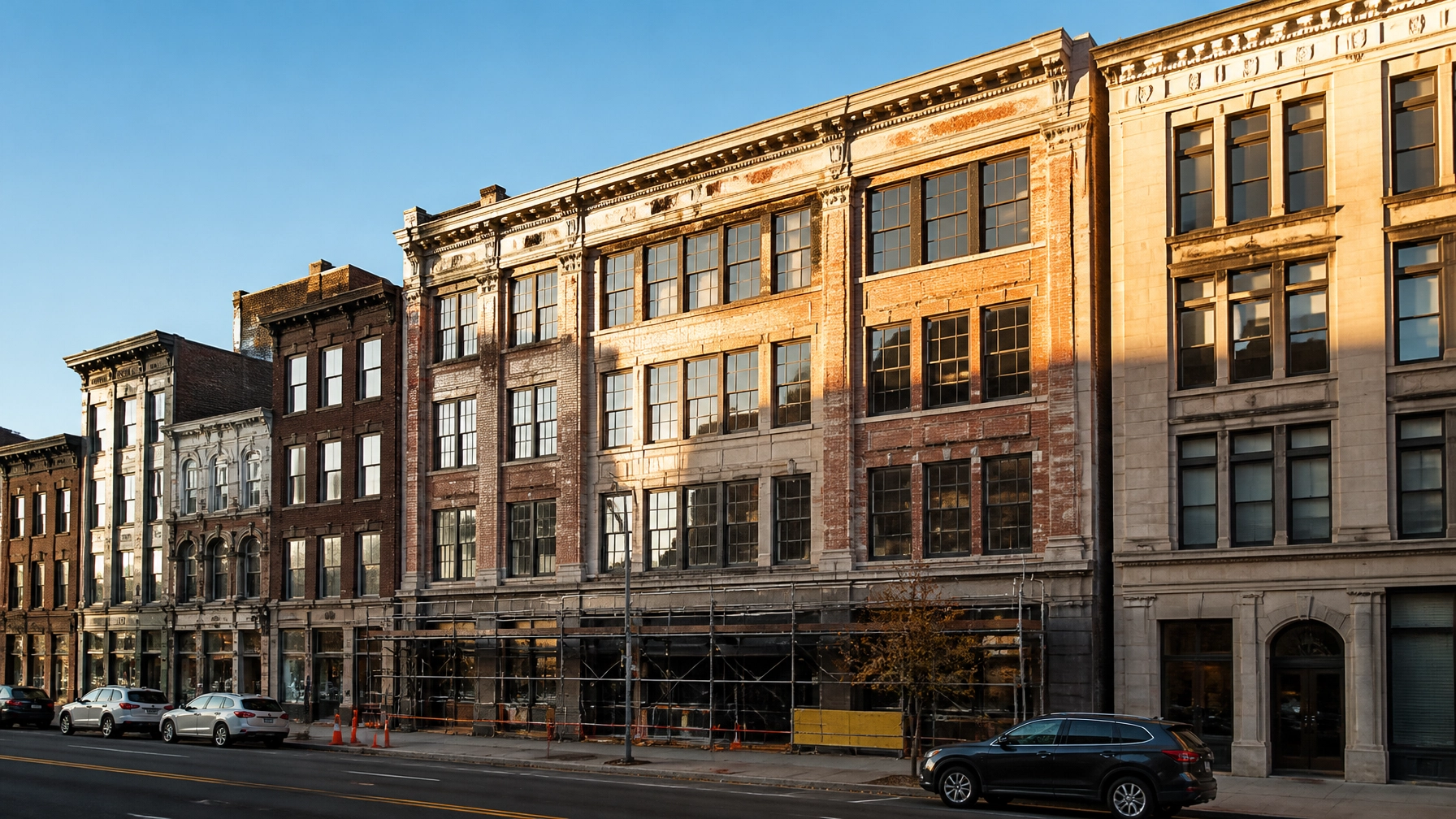
Albany’s downtown housing strategy is creating new opportunities for developers to convert underused commercial buildings into apartments, but the simplest way to understand the tax benefits is to focus on one number: the increase in assessed value created by the improvements.
That distinction matters because most local abatements do not erase taxes on the land or the building’s original assessed value; instead, they reduce or delay taxes on the additional value produced by a conversion, rehabilitation or historic restoration.
For property owners, investors and residents following Upstate New York news, the approach could help determine which downtown projects move forward, how rents are structured and whether vacant office space becomes housing rather than remaining underused.
The key Albany incentive: the 485-a exemption
The City of Albany’s primary local tool for converting nonresidential property into mixed-use housing is the Residential-Commercial Urban Exemption, authorized under Section 485-a of New York’s Real Property Tax Law.
The program provides a declining, 12-year partial exemption from real property taxes and certain special levies on the increased assessed value resulting from eligible improvements.
A typical qualifying project could include:
- A vacant office building converted into apartments.
- A commercial structure with ground-floor retail and upper-floor housing.
- An underused downtown property renovated for residential and commercial occupancy.
- A historic building adapted for multifamily use while retaining commercial space.
The application must be filed with the City of Albany assessor by the applicable taxable status date. Capitalize Albany identifies the City of Albany Tax Assessor as the primary contact and advises applicants to confirm filing requirements and deadlines directly.
The program generally continues after its initial approval without annual reapplication, provided the property remains eligible.
The practical lesson is straightforward: a developer should establish the property’s assessed value before construction, estimate the post-renovation value, and calculate the difference. That incremental value is the portion most directly affected by the abatement.
A simple example of the tax calculation
Consider a hypothetical downtown building with an assessed value of $2 million before renovation.
A developer spends $8 million converting the property into 60 apartments with ground-floor commercial space. After completion, the assessor determines that the property’s assessed value has increased to $6 million.
The tax calculation would not begin with the full $6 million for purposes of the improvement exemption. The relevant improvement increment would be approximately $4 million.
If the project qualifies for 485-a, the abatement would apply to that added value under the program’s declining schedule. The original $2 million assessment would remain subject to applicable taxes, while the improvement-related portion would receive the approved exemption.
The actual benefit would depend on the final assessment, local tax rates, eligible costs, building classification and the schedule approved by the assessor. The example is not a tax estimate, but it shows why the distinction between total property value and new assessed value is central to the financing model.

Why the incentive is aimed at mixed-use buildings
Albany’s downtown residential initiative is designed to increase housing while preserving the commercial activity that supports a walkable neighborhood.
Capitalize Albany reports that more than $175 million has been invested in downtown residential development, with more than 1 million square feet of obsolete commercial office space converted and nearly 1,000 units completed as of 2024. The organization also reported hundreds of additional units under construction or in the pipeline.
The 485-a structure fits that strategy because it is aimed at properties that combine residential and commercial uses rather than isolated suburban development.
For developers, the incentive can improve a project’s operating outlook during the years when debt service, insurance, maintenance and construction costs are highest. For residents, the benefit can be indirect but significant: lower operating expenses may help projects include more apartments, preserve existing storefronts or support mixed-income rents.
The abatement does not guarantee affordability, and it does not automatically require a project to include income-restricted units. Those conditions may arise through separate financing agreements, public subsidies or negotiated PILOT arrangements.
Historic buildings may qualify for an additional local abatement
Albany also offers a separate Historic Property Tax Abatement for qualifying improvements to historic properties.
According to Capitalize Albany, the exemption applies to the increase in value attributable to alterations, rehabilitation or renovation. The city portion provides a five-year 100% abatement on that increase, followed by reductions over the next six years until taxes are paid on the full assessed value.
The historic-property program applies only to City of Albany property taxes, not county or school taxes. Projects must also meet applicable preservation requirements and may need approval from local preservation authorities.
That limitation is important when developers prepare a financial model. A historic abatement should not be treated as a full replacement for the 485-a exemption, an IDA PILOT or state and federal historic tax credits. Instead, the project team must determine which benefits apply to which tax jurisdiction and whether the programs can be combined.
Historic conversions may also qualify for federal and New York State rehabilitation tax credits when the building and rehabilitation work meet program requirements. Capitalize Albany’s tax credit resources provide a starting point for reviewing those options.
When an IDA PILOT may be more useful
Larger multifamily developments often need more predictable tax treatment than a standard property-tax exemption can provide.
The Albany Industrial Development Agency can consider several forms of assistance, including:
- Real property tax abatements through a PILOT agreement.
- New York State sales and use tax exemptions on eligible construction materials and equipment.
- Mortgage recording tax exemptions.
- Project-specific financing and development arrangements.
A PILOT, or payment in lieu of taxes, replaces some or all standard property-tax payments with a negotiated schedule for a defined period. The structure can be particularly important for projects with high construction costs, affordability requirements or complex adaptive-reuse work.
IDA benefits are not automatic. Developers generally must submit a project application, development budget, financing plan, employment or community-impact information and other materials for agency review.
The main difference is that 485-a is a statutory exemption tied to qualifying conversion work, while an IDA PILOT is a negotiated economic-development agreement. A project may need one, the other or a carefully structured combination, subject to legal and agency review.
State and regional financing can close the remaining gap
Tax abatements reduce expenses, but they do not pay for construction. Downtown conversions frequently require multiple layers of financing.
The Downtown Albany Strategy and the state-backed Championing Albany’s Potential initiative have identified housing investment and transformative development as priorities. Program availability, eligibility rules and application procedures should be confirmed before a project relies on any proposed funding.
New York State Homes and Community Renewal also administers multifamily financing programs that can support affordable and mixed-income housing, including tax-exempt bond financing, capital subsidies and tax-credit structures. Developers can review current program information through HCR’s multifamily finance resources.
These programs may carry requirements involving:
- Income limits.
- Rent restrictions.
- Long-term affordability.
- Prevailing wage or labor standards.
- Energy efficiency.
- Supportive housing or resident services.
- Construction and compliance reporting.
A building that qualifies for a local tax abatement may not qualify for every state housing program. Early coordination among the architect, tax counsel, lender, assessor and public agencies is therefore essential.

What residents should know
Residents cannot generally apply for the 485-a exemption themselves because it is tied to property improvements and is typically pursued by the owner or development team.
Residents can, however, use the public approval process to track how incentives affect a project. Questions worth asking include:
- How many total apartments will be created?
- Will any units be income-restricted?
- How long will affordability requirements remain in place?
- Will commercial space remain available at street level?
- Does the project receive an IDA PILOT, and what public benefits are required?
- Will historic features be preserved?
- Are infrastructure, parking and neighborhood services adequate for the added population?
Small property owners may also encounter separate city or county incentives for accessory dwelling units or residential improvements, but those programs are not substitutes for the downtown conversion tools designed for larger buildings.
The practical checklist for developers
Before purchasing or renovating a downtown Albany property, a development team should:
-
Confirm the building’s current use and assessment.
The 485-a program is designed for qualifying nonresidential properties converted to mixed residential-commercial use. -
Separate existing value from improvement value.
A detailed appraisal and assessment review can clarify the potential tax benefit. -
Contact the Albany assessor early.
Confirm the taxable status date, required forms, eligible work and documentation. -
Review historic eligibility before construction begins.
Preservation standards can affect design, materials, windows, façades and interior features. -
Compare 485-a with an IDA PILOT.
The best structure depends on project size, affordability, financing and tax jurisdiction. -
Coordinate state financing applications.
HCR and other programs may require affordability commitments and detailed underwriting. -
Avoid assuming that proposed incentives are active.
Legislative proposals and state programs can change, expire or require local adoption.
The most reliable “trick” in Albany’s housing tax system is not a loophole; it is disciplined project accounting. Developers who calculate the tax impact on the improvement increment, verify local eligibility and layer incentives lawfully can better assess whether a downtown conversion is financially feasible.
For continuing Albany NY news and broader New York real estate news, New York News Daily will continue tracking the projects, policies and public decisions reshaping the Capital Region.

Sources and official resources
- Capitalize Albany: Downtown Residential Projects
- Capitalize Albany: Real Property Tax Abatement Programs
- City of Albany Industrial Development Agency
- City of Albany Downtown Albany Strategy
- New York State Homes and Community Renewal multifamily financing
Tax programs, eligibility standards and filing deadlines can change; property owners and developers should confirm current requirements with the City of Albany Tax Assessor, Albany IDA, qualified counsel and relevant state agencies before making financial or construction decisions.