

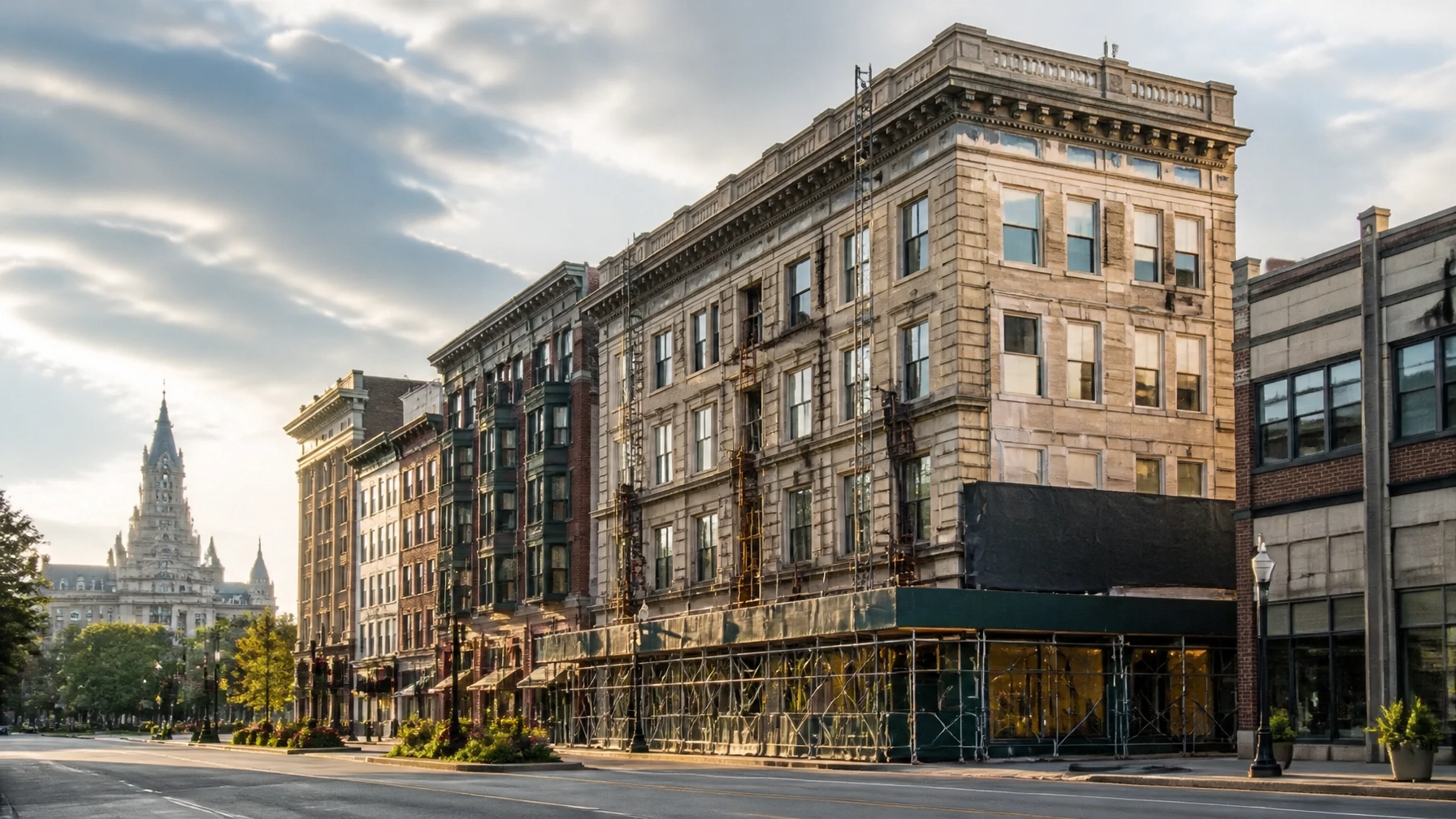
Custom editorial image depicting downtown Albany redevelopment.
Albany has approved nearly $7.4 million in tax incentives for three housing projects expected to add 204 apartments downtown, but the easiest way to understand the package is to separate the benefits into two categories: upfront project savings and long-term property-tax relief.
The decision, approved through the Albany Industrial Development Agency, connects public incentives to nearly $50 million in private real estate investment across three developments.
For readers following Upstate New York news, Albany NY news, and New York real estate news, the central question is straightforward: What exactly is being reduced, who qualifies, and why does Albany believe the trade-off will strengthen downtown?
The simple trick: Follow the money in two buckets
The reported $7.4 million total is not one direct payment to developers, and it is not a rent discount for future residents.
Instead, the incentive package is divided into two main parts:
- About $2.57 million in upfront tax exemptions tied to construction and financing.
- About $4.8 million in long-term property-tax savings under negotiated tax agreements.
The first category includes exemptions from certain state sales and use taxes on project-related purchases, along with relief from mortgage recording taxes connected to financing.
The second category involves long-term property-tax arrangements that allow a redeveloped property to make payments under an agreed schedule rather than immediately paying taxes based on its full post-construction assessment.
That distinction matters because construction costs arrive before a building produces rental income, while property taxes continue for decades after a project opens.
A quick example
If the entire incentive package were divided evenly across the 204 planned apartments, it would equal roughly $36,275 per unit over the life of the benefits.
That figure is only a rough way to understand the scale; it is not a payment to tenants, a guaranteed rent reduction, or an amount assigned equally to each apartment.
The actual value depends on each project’s cost, financing, assessment, tax agreement, and exemption schedule.
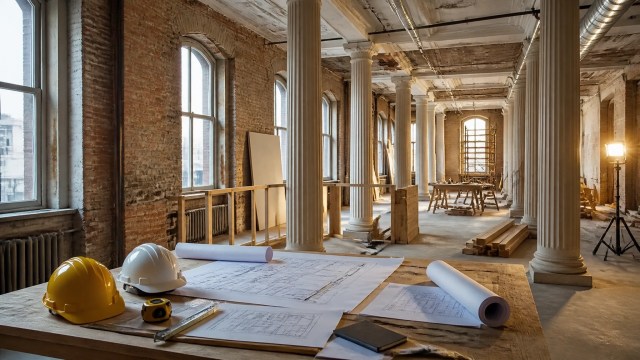
Adaptive reuse can require major structural, mechanical, and code upgrades before an older building can support new housing.
Which projects are receiving the incentives?
The three projects have different locations and redevelopment strategies, but together they illustrate Albany’s broader effort to turn underused commercial and historic properties into housing.
54 State Street: 120 apartments
The largest project is a planned $26.5 million conversion of a 10-story office building at 54 State Street.
Developer Ryan Jankow plans to create approximately 120 apartments while retaining commercial activity on the ground floor, including a bank and coffee shop.
The project reflects one of the most important changes in downtown real estate: office buildings that once depended on a large daytime workforce are being reconsidered as places where people can live around the clock.
Converting offices is not a simple matter of adding bedrooms and kitchens, however.
Developers may need to upgrade elevators, plumbing, heating and cooling systems, fire protection, electrical infrastructure, windows, insulation, accessibility features, and emergency exits.
The tax incentives are designed to reduce some of those costs and improve the project’s financial feasibility.
Kiernan Plaza: 50 apartments
The second project involves Kiernan Plaza, the historic building formerly known as Union Station.
Redburn Development Partners is planning an estimated $18.6 million redevelopment with approximately 50 apartments and commercial space.
The project combines housing creation with historic preservation and adaptive reuse, allowing an important downtown structure to remain active rather than standing partially vacant.
Historic buildings can offer distinctive features such as large windows, masonry facades, high ceilings, and ornate architectural details, but those same features can make renovations more expensive.
Preserving original materials while meeting modern building, energy, accessibility, and safety standards often requires specialized work.

Custom editorial image illustrating the adaptive reuse of a historic downtown transportation building.
Ontario Street: 34 apartments
The third project targets an unoccupied building on Ontario Street, near Albany High School.
Local developer Patrick Chiou plans to invest nearly $4.8 million to convert the property into a three-story apartment complex with 34 units.
Unlike the larger downtown conversions, the Ontario Street project focuses on bringing a vacant property back into productive use in an area identified by the city as needing reinvestment.
That makes the project significant beyond its unit count.
A smaller apartment development can add residents, increase neighborhood activity, support nearby businesses, and improve the condition of a property that might otherwise remain unused.
Who qualifies for Albany’s housing tax breaks?
The most important eligibility point is that these incentives are aimed at developers and qualifying real estate projects, not individual renters.
A tenant does not apply for a share of the $7.4 million package, and a future apartment resident should not assume the incentives will automatically produce below-market rent.
The project-level qualification is based on factors such as:
- The creation of new housing units.
- Significant private investment.
- Conversion or rehabilitation of vacant, underused, commercial, or historic properties.
- A measurable economic-development benefit for Albany.
- Compliance with the terms approved by the IDA.
- Completion and operation of the project according to the negotiated agreement.
The reported projects meet those broad objectives through a combination of office conversion, historic redevelopment, mixed-use construction, and neighborhood reinvestment.
The exact terms are project-specific, meaning the value, timing, and conditions of each tax benefit can differ.
Developers considering similar projects would generally need to work with the IDA, the city assessor, planning officials, lenders, and other agencies before construction begins.
The Capitalize Albany downtown residential program identifies several tools used to support downtown housing, including IDA assistance, financing programs, grants, and the city’s Residential-Commercial Urban Exemption under New York’s 485-a law.
What is the 485-a exemption?
Albany’s 485-a program is designed to encourage the conversion of nonresidential property into a combination of residential and commercial uses.
According to Capitalize Albany, the program provides a declining 12-year partial exemption on the increase in assessed value created by eligible improvements.
The basic concept is simple:
- A building has an existing assessed value.
- The owner invests in conversion or rehabilitation.
- The completed project is worth more.
- The exemption reduces taxes on some or all of that increased value for a defined period.
- The benefit gradually declines before the property returns to full taxation.
The program is particularly relevant to office-to-apartment conversions because the property’s value can rise sharply after redevelopment.
The 485-a exemption is not identical to every IDA benefit, and it should not be assumed that each of the three approved projects uses the same combination of programs.
The City of Albany assessor’s office and the IDA are the appropriate sources for confirming a property’s specific exemption, filing requirements, and schedule.
Why do the incentives matter for development?
Supporters argue that downtown housing projects often face a financial gap between what construction costs and what rents can realistically support.
That gap can be especially wide in older buildings.
An office conversion may require extensive demolition and new systems, while a historic building may require preservation work that adds cost without creating additional rentable space.
A tax exemption can help close that gap by lowering expenses during construction and stabilizing operating costs after completion.
The incentives may also make lenders more comfortable because a predictable tax agreement can improve a project’s long-term financial projections.
For Albany, the larger objective is to create a downtown with more residents, not only more office workers and visitors.
City officials have previously set a goal of significantly increasing the number of people living downtown and attracting more than 2,300 additional residents by 2035.
More residents could support restaurants, stores, cultural venues, transit, and evening activity.
Capitalize Albany reports that the city’s downtown residential strategy has already helped convert more than 1 million square feet of obsolete commercial office space and generated more than $175 million in downtown residential investment.
The new 204 apartments therefore fit into a longer redevelopment strategy rather than standing alone as a single housing announcement.
What are the concerns?
The public debate centers on whether the long-term benefits justify the tax revenue forgone in the short term.
Critics may question whether private projects would proceed without incentives, whether the apartments will be affordable to a broad range of residents, and whether the city receives enough public value in exchange for the tax relief.
Supporters counter that vacant buildings produce limited economic activity, while occupied apartments can generate demand for local services and help stabilize downtown neighborhoods.
The answer will depend on execution.
The projects must be completed, the apartments must be occupied, and the surrounding downtown economy must capture enough new activity to offset the public cost of the incentives.
The $7.4 million headline therefore represents a policy bet: Albany is accepting reduced tax revenue in the near term in hopes of creating a larger, more active, and more valuable downtown over time.

Custom editorial image illustrating the relationship between building rehabilitation and downtown neighborhood activity.
What should residents watch next?
The next important developments will be construction progress, final apartment counts, leasing activity, commercial occupancy, and the public release of project-specific tax agreements.
Residents should also watch whether the new apartments include a meaningful range of sizes and rents, whether ground-floor commercial spaces open as planned, and whether additional vacant buildings enter the redevelopment pipeline.
For developers, the message is that Albany is continuing to assemble multiple tools to support housing production, including IDA assistance, property-tax exemptions, financing programs, and historic-rehabilitation resources.
For residents, the message is more limited but still important: the incentives may increase the city’s housing supply, but they do not automatically guarantee affordability or direct financial relief.
The clearest way to understand Albany’s new downtown housing tax breaks is to remember the two buckets: upfront savings that reduce construction and financing costs, and long-term tax agreements intended to make completed projects financially sustainable.
If the three developments deliver their promised 204 apartments, Albany will gain new housing while putting several underused properties back into service, giving the city’s downtown strategy a significant test in public view.
For continuing New York real estate news, follow New York News Daily’s coverage of housing, development, business, and economic change across the Capital Region.