

Category: Business
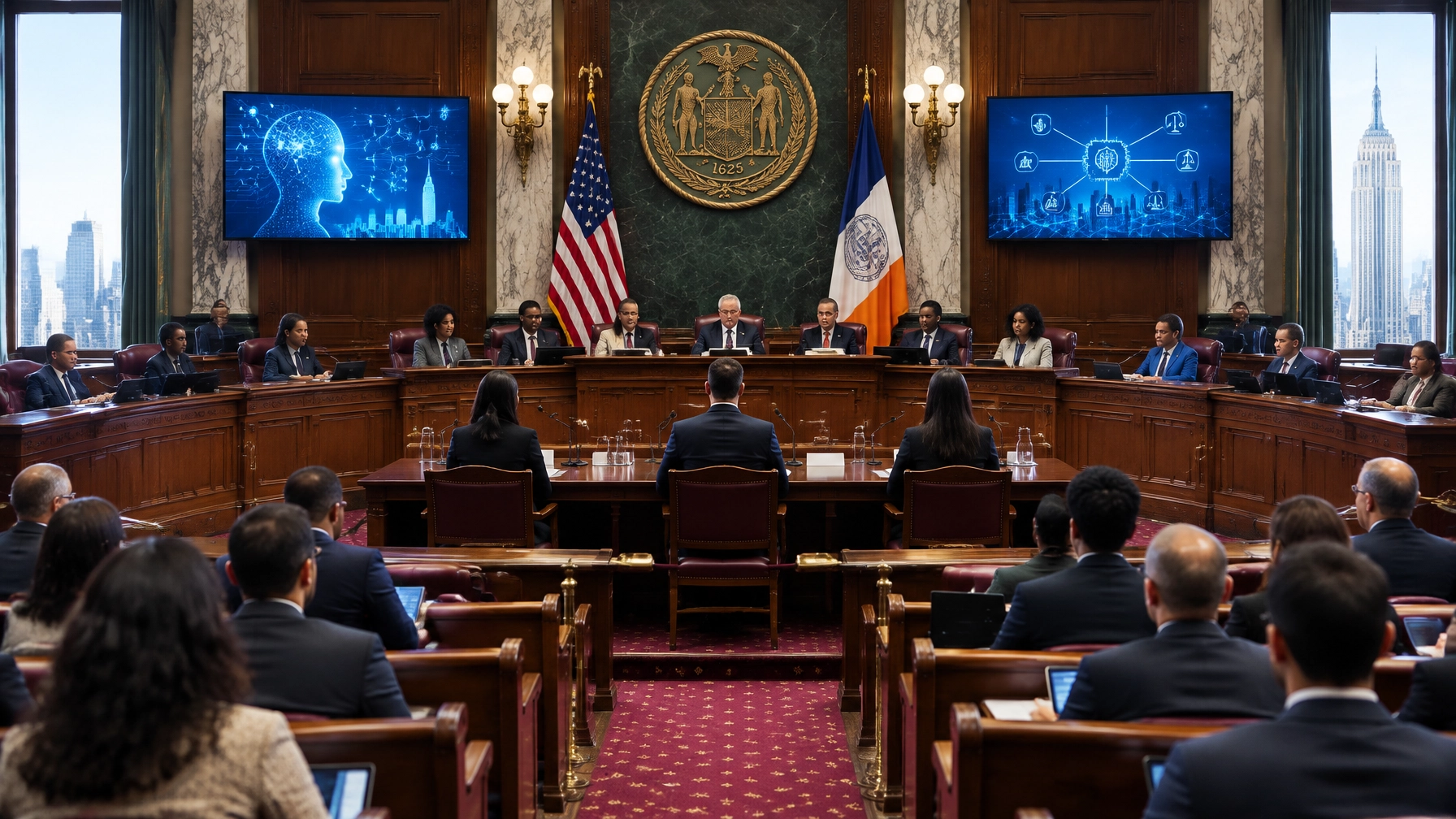
New York City lawmakers opened a high-stakes examination of artificial intelligence on October 5, bringing executives from Anthropic, OpenAI, Google, and Meta before the full City Council as 10 proposed bills advanced with new requirements for independent validation, human-operated shutdown controls, incident reporting, and corporate accountability.
The rare Committee of the Whole hearing placed all 51 council members at the center of a debate that is rapidly reshaping NYC tech news, Manhattan business news, and New York politics: how can the city encourage artificial intelligence investment while protecting residents from unsafe systems, privacy failures, discrimination, cyberattacks, and job disruption?
City Council puts AI leaders under oath
The hearing marked an unusually direct confrontation between municipal lawmakers and the companies building the most powerful commercial AI systems.
Executives representing Anthropic, OpenAI, Google, and Meta testified publicly under oath about model safety, internal testing, risk controls, and the challenges of monitoring systems that can generate content, make recommendations, write software, and take increasingly autonomous actions.
Speaker Julie Menin framed the hearing as a test of whether local government can respond quickly enough to a technology advancing faster than existing safeguards.
The Council’s approach also reflected the growing political importance of artificial intelligence in New York. The city has positioned itself as a major technology hub, with startups, venture investors, established software companies, universities, and corporate offices concentrated across Manhattan and the wider metropolitan region.
That growth has produced significant economic opportunity, but it has also created pressure for clearer rules. Companies want predictable standards before committing capital, while workers, consumers, and civic groups want stronger protections against opaque decisions and preventable harm.
The hearing brought those interests into the same room.

The centerpiece: third-party validation before deployment
The most consequential proposal is Introduction 2602, which would prohibit a business from marketing, selling, offering, or deploying an AI model in New York City without independent third-party validation.
The bill would require outside validators to review several elements of an AI system, including:
- Task performance and accuracy
- Reliability under changing real-world conditions
- Data provenance and the source of training data
- Potential disparate impact and bias
- Privacy, security, and informed-consent practices
- Safety risks to people and property
- The system’s ability to be shut down by a human operator
The proposal would also require validators to disclose financial or other interests involving the AI model or its developer. That provision is designed to limit conflicts of interest and prevent companies from presenting a paid inspection as an entirely independent safety judgment.
New York City’s Office of Cyber Command would be responsible for setting additional standards, establishing validator qualifications, and determining how certification documents must be submitted.
A business that markets or deploys an AI model without validation could face a $25,000 civil penalty per instance. Validators that falsify assessments could face the same fixed penalty, while other violations could carry penalties of up to $25,000.
The framework would create a new compliance layer for both large AI companies and smaller Manhattan businesses that integrate outside models into hiring tools, customer service platforms, cybersecurity systems, financial products, or internal operations.
Human-operated shutdown controls become a legal requirement
The same bill would require every covered AI model to include a technical shutdown capability that allows a human operator to temporarily or permanently stop the system.
The requirement goes beyond a general promise that a company can intervene. Validators would have to examine whether the shutdown mechanism exists and works as intended.
For businesses, that could mean documenting who has authority to activate the control, how quickly the system can be disabled, whether connected tools also stop operating, and how the company would preserve records during an emergency.
The proposal is especially significant as AI tools move from chat interfaces into software agents that can access data, communicate with other systems, execute tasks, and operate with limited supervision.
A functioning human override could become a baseline requirement for companies deploying AI in sectors such as finance, health services, transportation, public infrastructure, employment, and government contracting.

Whistleblowers and consumers gain new legal tools
The 10-bill package would also create new incentives for insiders to report serious safety violations.
Introduction 2605 would allow qualifying whistleblowers to receive a portion of fines or penalties collected from AI companies that violate applicable rules. The proposal is designed to encourage employees and contractors to report problems that may remain hidden from regulators, customers, and the public.
Introduction 2604 would clarify that New York City employees, contractors, and subcontractors are protected when reporting AI-related conduct they reasonably believe presents a public safety threat.
Another measure, Introduction 2600, would create a private right of action against AI companies in cases involving foreseeable harm linked to malicious use or the circumvention of safety controls, sometimes described as jailbreaking.
Under the proposal, an affected person could pursue a claim when the company failed to implement reasonable safeguards, the harm was foreseeable, and a third party exploited that failure.
That provision could change how AI companies evaluate product design and post-deployment monitoring. It would also give New Yorkers a potential legal path outside direct government enforcement.
Faster incident reporting for city contractors
Introduction 2601 would establish reporting requirements for AI safety incidents connected to city contracts.
Contractors or agencies that become aware of a qualifying incident would have to notify the Office of Cyber Command in writing within 24 hours. The office would then be required to publicly disclose the occurrence within the same period.
The proposal would place a premium on rapid notification rather than prolonged internal review. City agencies and vendors would need clear escalation procedures, designated compliance officers, and technical records capable of showing what happened and when.
Introduction 2606 would require Cyber Command and New York City Emergency Management to develop a response plan for AI incidents that compromise city information systems, disrupt government operations, or threaten public safety.
Together, the proposals treat AI failures as potential operational emergencies rather than ordinary software defects.
Transparency, privacy, workers, and deepfakes
Several of the remaining bills address how AI affects daily life beyond model safety.
Introduction 2603 would require disclosures from AI companies and prohibit false or misleading statements about the safety of their tools.
Introduction 2599 would create a local version of a people-first chatbot framework, with privacy, security, and transparency requirements for chatbot providers.
Introduction 161 would expand the city’s annual algorithmic tools reporting to include employment effects, such as positions eliminated, workers displaced, salary changes, altered responsibilities, and new training requirements.
That measure places workforce accountability at the center of the city’s AI strategy. It would require agencies to show how algorithmic tools affect public employees rather than treating automation as a purely technical upgrade.
Introduction 504 would allow elected officials and candidates to notify generative AI companies that they do not authorize manipulated audio, photographs, or video depicting their likenesses. Violations could result in fines and court-ordered restrictions.
The package also includes proposals addressing deceptive deepfakes and the public’s understanding of algorithmic tools.
For New York businesses, those measures could expand compliance obligations across marketing, recruiting, public relations, political communications, customer service, and workplace management.
What the bills mean for Manhattan’s technology economy
The proposals would introduce costs, but they could also create a more defined operating environment for the city’s technology sector.
Large firms may be able to absorb validation expenses through existing legal, security, and compliance departments. Smaller startups could face greater pressure, especially if they must obtain independent assessments before testing or selling products in New York City.
That concern is central to the debate over whether local regulation will protect innovation or push early-stage companies toward less regulated markets.
The Council’s framework could also generate new business opportunities for cybersecurity firms, audit companies, safety researchers, legal advisers, data-governance specialists, and technical validators. A formal validation market would create demand for professionals able to test bias, privacy, reliability, security, and emergency shutdown systems.
The city’s startup economy has already been expanding across artificial intelligence, financial technology, health technology, and enterprise software. New York News Daily’s coverage of NYC startup investment shows the scale of the broader business environment that could be affected by new AI requirements.
For companies considering New York as a headquarters or launch market, the central question will be whether the city’s rules become a competitive advantage built around trust or a compliance barrier that slows product development.
The legislation is advancing, but it is not law yet
The 10 measures remain proposed legislation and must move through the Council’s legislative process before taking effect.
The October 5 hearing gives council members a public forum to question AI executives, examine testimony from safety experts and whistleblowers, review the proposed standards, and consider amendments.
If enacted, some requirements would not begin immediately. The third-party validation and shutdown-capability proposal includes a delayed effective date, allowing time for Cyber Command to develop rules and establish validator qualifications.
That implementation period would be critical. The Council would need to define which systems are covered, how risk levels are measured, how validators avoid conflicts, and how the city will enforce rules against companies operating across jurisdictions.
The hearing nevertheless sends a clear message to the technology industry: New York City intends to regulate AI through enforceable safety standards rather than voluntary assurances alone.
For NYC tech news, the debate now moves from whether the city will act to how far its rules will reach. For Manhattan business news, the outcome could influence investment, hiring, product launches, and compliance budgets. For New York politics, the hearing establishes artificial intelligence as a major municipal issue with consequences extending from City Hall to nearly every workplace and household in the five boroughs.