

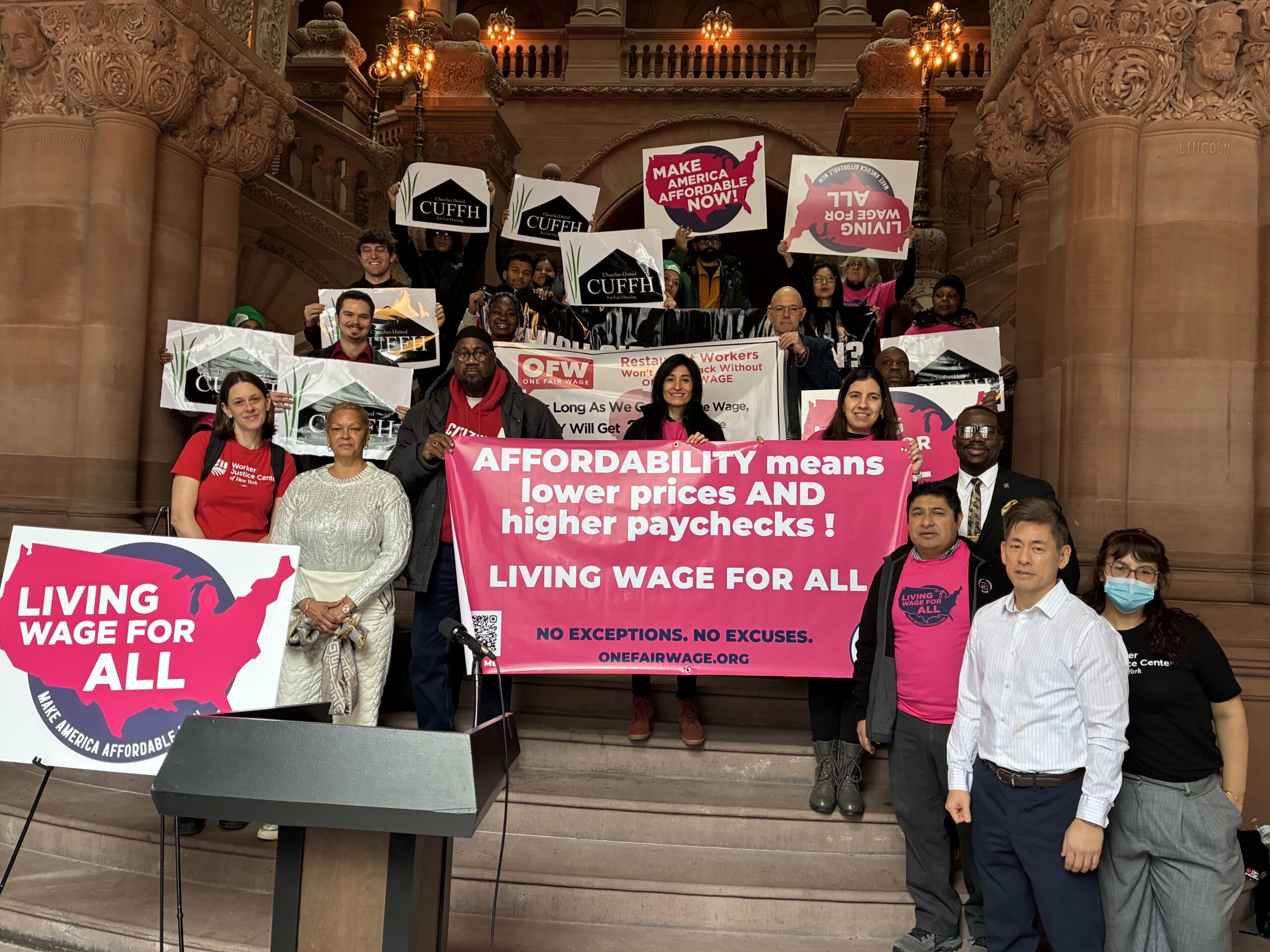
Today at the New York State Capitol, lawmakers, workers, and advocates formally launched the Living Wage for All New York campaign, unveiling a comprehensive legislative package aimed at raising wages statewide and eliminating all remaining subminimum wages across industries.

State Senator Julia Salazar, Assemblymembers Demond Meeks, Jessica González-Rojas, and Phil Steck, along with State Senator Robert Jackson, were joined by worker leaders and coalition partners representing labor, disability rights, immigrant rights, racial justice, women’s rights, and community organizations from across the state.
Organizers called for swift legislative action during the 2026 session, arguing that New York’s affordability crisis cannot be solved by focusing on prices alone. With housing, food, utilities, and health care costs continuing to rise, advocates said wages have failed to keep pace, leaving many working families unable to cover basic needs or plan for the future.
Ending Subminimum Wages as a First Step
As an immediate step toward a true living wage, the legislative package would eliminate all remaining subminimum wages, including those affecting tipped restaurant workers, workers with disabilities, and incarcerated workers.
The proposal is anchored by the newly introduced Living Wage for All New York bill, sponsored by Senator Salazar. The bill would raise the minimum wage closer to a true living wage tied to the actual cost of living, with a long-term benchmark approaching $30 per hour in high-cost regions. It would also eliminate regional wage disparities and index future increases to cost-of-living metrics to ensure wages do not fall behind again.
The package also includes the One Fair Wage Act (A1200A, S415A), sponsored by Assemblymember González-Rojas and Senator Jackson. The bill would eliminate the tipped subminimum wage for restaurant and hospitality workers while offering a phased employer credit to support a smooth transition.
Additional companion legislation, including bills sponsored by Assemblymember Steck and others, would raise wages for workers with disabilities, increase pay for incarcerated workers, and allow local governments to adopt higher minimum wages when local costs demand it.
New Report Highlights Wage Gaps

Advocates also pointed to findings from a new One Fair Wage report showing that nearly 318,000 tipped workers were excluded from New York’s most recent wage increases. The report found that subminimum wage policies continue to depress earnings across the restaurant industry and that many low-wage workers earn too little to benefit from tax-based affordability proposals.
Organizers argued that subminimum wage laws shift labor costs onto workers and customers rather than employers, and that raising base wages is the most direct and reliable way to improve economic security for working families.
Lawmakers and Advocates Speak Out
“People in my district are working multiple jobs and still falling behind,” said Senator Salazar. “The affordability crisis gripping New Yorkers is not just about soaring prices; it is also about wages that are too low to live on. This legislation gets to the core of the problem by raising pay and ending subminimum wages so no worker is left out.”
“Hundreds of thousands of tipped workers were left out of wage increases because our laws still allow subminimum wages,” said Assemblymember González-Rojas. “Ending the subminimum wage is how we deliver real raises, every paycheck, for workers who have been left behind.”
Senator Jackson emphasized the moral stakes of the legislation, saying, “Work should be the surest path to dignity, not a trapdoor into poverty. For too long, subminimum wages have legalized inequality and carved our workforce into tiers.”
Assemblymember Steck added that eliminating subminimum wages would provide meaningful long-term benefits for tipped workers and members of the disability community by recognizing their labor and dignity.
Assemblymember Meeks highlighted the broader economic impact, saying that when workers can afford rent, food, and basic necessities, neighborhoods become stronger and more stable.
Senator Zellnor Myrie pointed to the connection between wage policy and justice reform, arguing that paying incarcerated workers pennies per hour undermines rehabilitation and long-term stability.
Community leaders echoed those concerns. Carola Otero Bracco of Neighbors Link said low wages are pushing families closer to crisis, while Jirandy Martinez of Community Resource Center warned that subminimum wages expose immigrant workers to exploitation. Donna Hylton of A Little Piece of Light described the practice of paying incarcerated workers as legalized exploitation that must end.
Michelle Jackson of the Human Services Council noted that low wages destabilize families and strain vital services, from housing and childcare to elder care.
Momentum Builds at the Capitol
Following the rally, workers, small business owners, and community leaders participated in a statewide lobby day, meeting directly with legislators to urge passage of the Living Wage for All Act, the One Fair Wage Act, and related measures.
Organizers said the day of action reflects growing momentum among labor, disability rights, immigrant rights, racial justice, and women’s organizations calling for bold solutions to New York’s affordability crisis and a wage system that leaves no worker behind.