

Category: Arts & Entertainment
Kinlaw will be lifted 150 feet above Times Square on Tuesday night for FALL RISK, a one-night performance that turns the district’s familiar spectacle toward the limits of the human body.
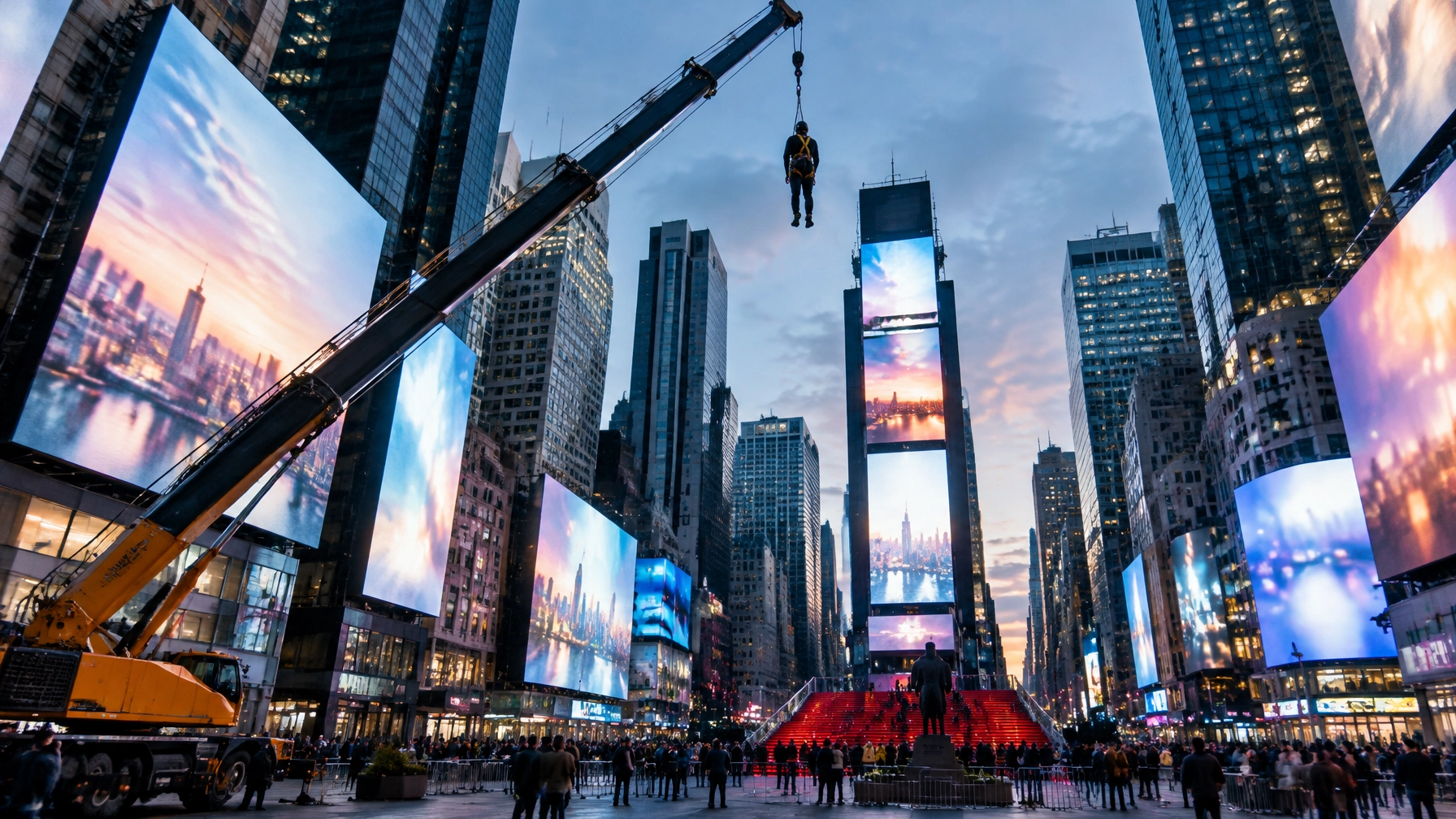
Presented by Times Square Arts, the New York City premiere is scheduled for 8 p.m. in Duffy Square and Broadway Plaza, between West 46th and 47th Streets. A 150-foot crane arm will suspend the artist above the plaza as a microphone carries Kinlaw’s breathing and voice to the audience below.
The event places a visibly vulnerable body against the scale and noise of Times Square. Instead of the fast-moving images and commercial displays that define the square, the performance asks viewers to focus on a person sustaining effort under physical pressure.
Viewing is centered on Duffy Square and the surrounding plazas, and the presenting organization has asked visitors to reserve a spot for the Red Steps, which offer an elevated vantage point over the performance.
Illustrative image; not a documentary photograph of the performance.
The performance
The crane is central to the work, not simply a way to raise Kinlaw above the crowd. The machinery makes the forces surrounding the suspended body visible: steel, weight, height and the careful operation required to hold the artist in place. Amplified breathing brings a quieter measure of strain into the public square.
Kinlaw describes the work as a collision between a body and the force of roughly 40,000 pounds of aluminum and steel. The artist has said the piece is shaped by caregiving, an aging family, financial precarity and survival, while taking place in a location built around spectacle and capital. Rather than represent those pressures at a distance, FALL RISK puts them under strain in real time.
That framing connects the performance’s physical risk to the systems that help determine whether people can obtain care. Kinlaw has drawn on personal experience navigating insurance and financial structures affecting care for aging and disabled parents. The work does not offer an easy resolution; it stages the pressure and asks what it means to endure it.

An illustrative view of the performance’s focus on breath, sound and the suspended body.
The artist
Kinlaw is a New York-based performance artist and composer whose work examines visibility, endurance and public exposure. Movement, sound and industrial structures recur in performances that place the body in demanding conditions and make those conditions legible to an audience.
Raised in a working-class family in the American South, Kinlaw brings a background in psychoacoustic research to the practice, drawing on four years of work at Bell Labs. Selected works have been presented at MoMA PS1, the New Museum, MOCA and the Park Avenue Armory.
FALL RISK is described as the artist’s most extreme and personal action to date. Its scale is striking, but its subject is not spectacle alone: the work ties visible physical endurance to less visible burdens of care, access and financial uncertainty.
The Times Square staging is only the second presentation of the piece. It was commissioned by Art Omi for curator Sara O’Keeffe and first performed in June 2025, with boom truck operator Mark Moeske and creative direction by Kathleen Dycaico.

Illustrative depiction of the crane’s scale in the Times Square setting.
A different Times Square lineage
The work arrives nearly a century after Harry Houdini was suspended from a crane in Times Square. That earlier feat drew attention to escape; Kinlaw’s performance advances a different proposition. Its central question is not how to get free, but what it takes to remain present under pressure.
That distinction shifts the terms of the spectacle. The audience is not asked to watch a trick resolve in a moment of release. Instead, the amplified breath and the duration of the suspended action direct attention to endurance itself.
Curator Sara O’Keeffe has framed the work as confrontational and tense, placing it in a lineage of performance where the body is put on the line in negotiation with larger structural forces. Here, the industrial machinery is literal, while the institutional and financial structures behind the work’s themes remain largely unseen.
The contrast is part of the piece’s force: an immense crane holds one person aloft, while the audience below confronts the distance between public visibility and the private realities of caregiving and survival.
The institutional framing
Times Square Arts presents FALL RISK as a public-art intervention that reorients the square’s spectacle around the body: its limits, resilience and exposure. Director Anna Starling has said the performance draws attention away from the district’s usual visual excess and toward the human scale of endurance.
That setting makes the work unusually public. The Times Square presentation places Kinlaw’s second staging before a much larger and more varied audience than a conventional gallery encounter, while the one-night format gives the performance a defined moment in the city’s daily flow.
Kinlaw’s piece joins a wide range of arts activity across the city, from experimental public performance to Broadway productions. New York News Daily’s Arts & Entertainment coverage tracks the season’s theater and cultural developments.
On Tuesday night, FALL RISK will make the body, not the billboard, the focal point of Times Square. Its high-stakes image is simple: one artist suspended above the crowd, a crane holding fast, and a voice carrying the sound of effort into a place built to keep people looking.