

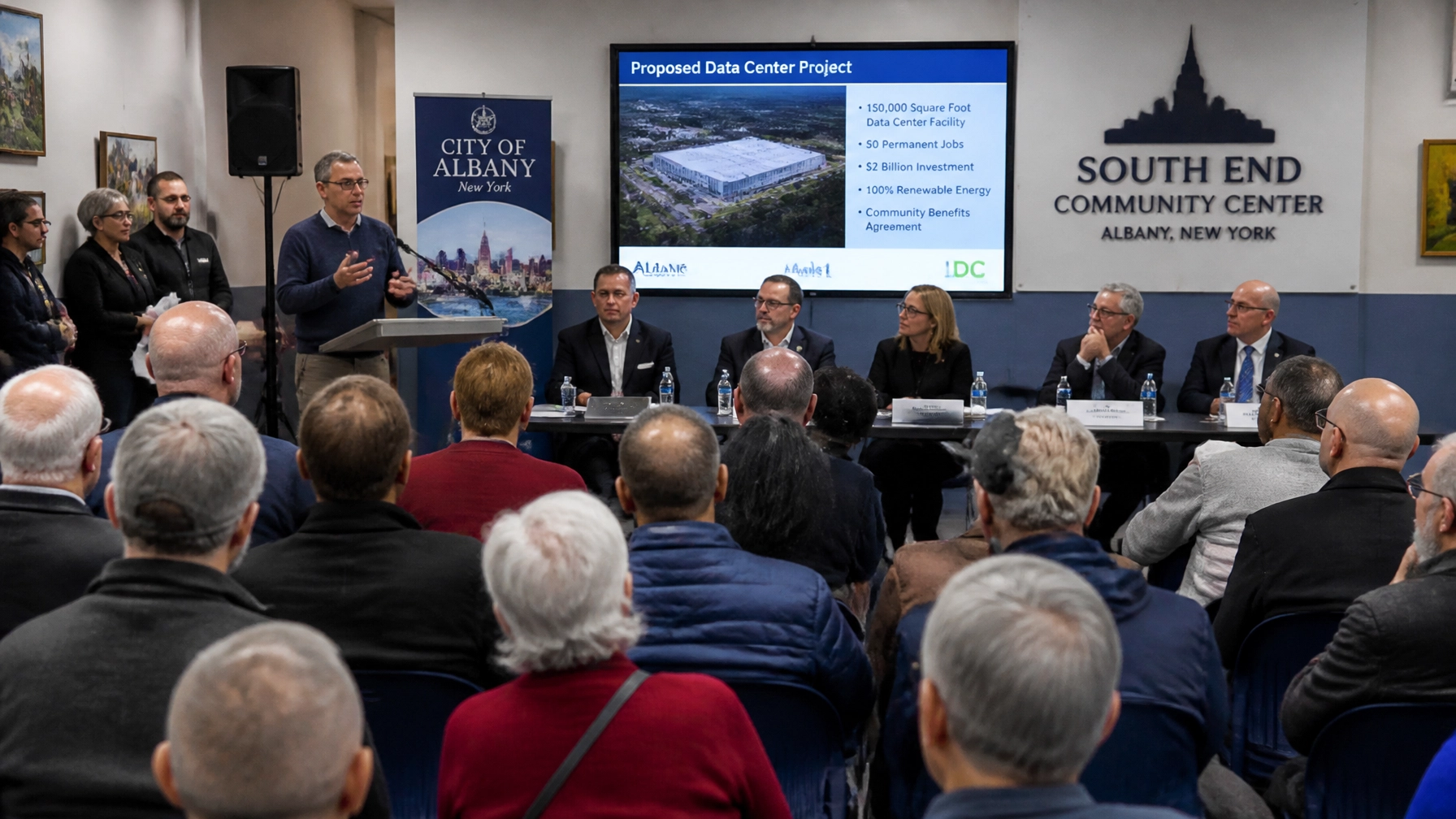
Representatives from the EKG Group faced an intense barrage of questions and community skepticism during a high-stakes public meeting at the Albany West/West Hill Community Center, as developers attempted to soothe mounting local concerns regarding the proposed Kenwood data center project. The gathering, which drew approximately 75 attendees including members of the Albany Common Council and the Albany County Legislature, underscored the deepening friction surrounding digital infrastructure expansion across Upstate New York news sectors.
The proposed facility, slated for the former Kenwood Convent site, has sparked robust debate throughout the Capital Region. As tech investments accelerate across New York, residents and local lawmakers have increasingly scrutinized the environmental and economic externalities tied to large-scale technological installations. During Wednesday evening's session, EKG Group executives sought to distance their proposal from heavier industrial installations that have dominated recent statewide headlines, emphasizing that the Kenwood initiative remains in its formative preliminary stages.
"This project won’t be like those other data centers dominating the news," developer representatives asserted to the packed room, pointing out that no formal application has yet been filed with municipal authorities. Despite these assurances, the dialogue quickly pivoted to core community anxieties involving utility loads, acoustic disturbances, and local housing dynamics.

Navigating Grid Capacity and Environmental Scrutiny
The intersection of artificial intelligence infrastructure and energy grid stability has rapidly emerged as a defining pillar of New York politics. As state legislators weigh statewide moratoriums on new data center construction, Albany-area stakeholders have grown acutely sensitive to the potential strains placed on local power grids.
During the Q&A portion of the meeting, attendees pressed EKG Group delegates on projected electricity consumption, potential impacts on residential utility rates, and comprehensive environmental impact reviews. Critics noted that data centers notoriously demand staggering amounts of continuous power and cooling water, raising profound questions about regional sustainability.
Furthermore, residents voiced sharp concerns over potential noise pollution and industrial vibrations emanating from continuous server operations adjacent to established residential neighborhoods. Local lawmakers reiterated that community protection remains paramount as municipal agencies evaluate whether such massive technological footprints align with Albany’s long-term urban planning goals.

Housing Affordability and Broader Regional Implications
Beyond energy and environmental impacts, the Kenwood project proposal has also entangled itself in broader discussions surrounding regional housing development. Plans for the site have historically included residential components, prompting intense local interest regarding affordability thresholds and community accessibility.
Community advocates demanded definitive clarity on the projected cost of planned apartments associated with the development, questioning whether incoming residential units would genuinely serve working-class Capital Region families or cater exclusively to higher-income demographics. The dialogue reflects a broader statewide tension between commercial expansion and the urgent demand for equitable housing infrastructure.
As local organizing intensifies: marked by neighborhood petitions and public rallies: the trajectory of the Kenwood proposal serves as a barometer for how Albany NY news will cover the intersection of corporate tech investments and civic oversight in the months ahead.

Next Steps in the Regulatory Process
With the preliminary community meeting concluded, attention now shifts toward official municipal filings and upcoming legislative reviews. The Albany Common Council continues to monitor statewide regulatory frameworks while local neighborhood associations organize formal opposition and oversight committees.
EKG Group faces the formidable task of bridging the gap between corporate development ambitions and neighborhood preservation. Whether subsequent design revisions and environmental guarantees will satisfy skeptical Albany residents remains one of the most critical local storylines of the summer, setting a definitive precedent for future technological development across Upstate New York.