

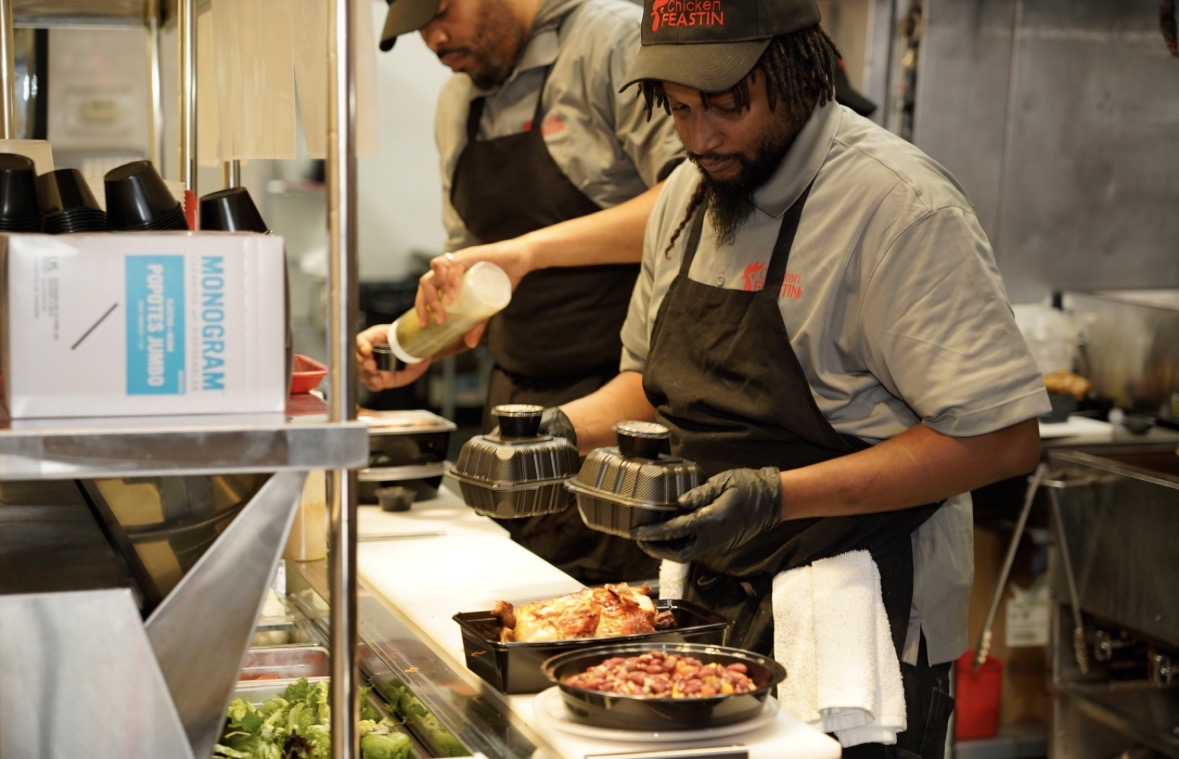
The Schenectady restaurant brings New York City roots, an evolving multicultural menu, staff-driven creativity, and a community-first vision to the Capital Region.
For Rena Martelle, opening Chicken Feastin in Schenectady was never simply about bringing another restaurant to the Capital Region. It was an opportunity to take a concept born in New York City, introduce it to a new community, and build something that could evolve alongside the people it serves.
Martelle, owner of Chicken Feastin’s Schenectady location, comes to the fast-casual restaurant world with a background that might surprise customers ordering the restaurant’s signature chicken, ribs, empanadas or cornbread. Before taking on Chicken Feastin, she worked in fine dining as a Michelin chef in New York City and continues to provide private fine-dining catering through Martelle Catering.

Her experience also extends beyond New York. Having worked and studied in multiple countries and grown up surrounded by different cultures, Martelle developed an appreciation for the way food can bring seemingly different communities together.
That perspective is now helping shape what she wants Chicken Feastin to become in Schenectady.
“I really wanted to create a restaurant that invited every aspect of the community to be involved creatively and professionally,” Martelle said.
Bringing a New York City Concept Upstate
Martelle’s path to ownership began through a relationship built on trust. Chicken Feastin’s original owner was a longtime family friend and mentor who believed her culinary background, ambition and willingness to experiment could help take the brand in a new direction.
The opportunity gave Martelle the chance to combine an established concept with her own ideas about food, restaurant culture and community.

Although Chicken Feastin originated in New York City, Martelle saw an opportunity for the concept to work beyond the five boroughs. After exploring several areas, Schenectady stood out.
The city may operate at a different pace than New York City, but Martelle saw similarities that mattered more than population size.
She found a close-knit community influenced by numerous cultures, along with residents who appeared receptive to new additions to the local food scene. For a restaurant built around an eclectic menu and a willingness to experiment, that diversity was important.
“I chose Schenectady because though it is a smaller city, it is just as close knit and diverse as NYC can be,” she said.
Instead of trying to recreate a New York City restaurant in Upstate New York, Martelle wants the Schenectady location to reflect the city around it.
A Menu Designed to Keep Changing
At the center of Chicken Feastin is its signature CharGrilled chicken, prepared using a two-day marinade and a specially designed machine created by the brand’s original owner.
For first-time customers, that is where Martelle recommends starting.
But it is far from where the menu ends.

Beef ribs, empanadas and an unconventional blueberry chocolate chip cornbread are among Martelle’s other recommendations. The menu draws inspiration from Greek and Mediterranean cooking while increasingly incorporating Caribbean, Dominican, Italian, Southern and other culinary influences.
Middle Eastern-inspired additions are also part of the restaurant’s plans.
What makes the Schenectady location particularly interesting, however, is that some of its menu development comes directly from the people working inside the restaurant.
Martelle has created what she calls an “excess management program,” an approach designed to simultaneously reduce food waste and encourage staff creativity.
Instead of automatically allowing excess ingredients to become waste, team members are encouraged to think about what else they can create with them. Those ideas can become new menu items and, in some cases, products developed around individual staff members.
That experimentation has already helped introduce items such as empanadas, different styles of cornbread and mac bowls.
It turns the kitchen into something closer to a culinary incubator than a rigid fast-casual operation.
For Martelle, that freedom is intentional.
“We create brands for staff members to sell their own products and encourage creativity with excess management so that food goes to hungry people and not to the trash,” she explained.
Customers can play a role too. Suggestions for new cookies, cakes, dishes and flavors can potentially inspire something that eventually finds its way onto the menu.
The result is a restaurant that does not necessarily expect its menu to look exactly the same years from now.
Martelle wants it to evolve.
Creating a Neighborhood “Chicken Coop”

There is another part of the Chicken Feastin concept that Martelle believes cannot be built through food alone.
She wants the Schenectady restaurant to feel local.
The goal is a family-oriented restaurant where customers can stop in for dinner but also feel comfortable celebrating birthdays, gathering with friends or reconnecting with family.
Martelle describes the environment as intentionally quirky and fun, with the restaurant continuing to make changes based on customer feedback. A mural is being developed to create another visual element for guests, while a charging station was added with students from nearby Union College in mind.
The restaurant’s Union Street location, situated near a bus stop, also puts it within reach of students, workers and residents moving through the neighborhood.
But Martelle’s idea of community extends beyond what happens inside the restaurant.
Chicken Feastin has become involved with Wimberly Athletics, a youth and adult athletics program led by Devon Wimberly. That relationship has helped connect the restaurant with programs throughout the area.
Martelle has also developed ties with Friendship Baptist Church under Pastor Hamilton and has supported City Mission through food donations.
Those relationships reflect a larger goal for the restaurant.
As Chicken Feastin becomes more established, Martelle hopes to work with additional churches, nonprofits, medical facilities, local organizations and the Union College community. The restaurant currently offers discounts for veterans, essential workers and students.
For Martelle, supporting the community is particularly important at a time when families are dealing with rising financial pressures.
It creates a simple expectation for the business: if the community supports Chicken Feastin, Chicken Feastin should find ways to support the community in return.

Building Through the Challenges
Opening a restaurant rarely happens without setbacks, and Martelle does not pretend the Schenectady launch has been an exception.
Construction issues, staffing challenges and the difficulty of building awareness in a new market have all been part of the experience.
Perhaps the biggest challenge has simply been getting enough people to know the restaurant exists.
For an independent operator competing for attention in an increasingly crowded food landscape, exposure can be the difference between being discovered and becoming another overlooked storefront.
Yet Martelle says the customers who have found Chicken Feastin have given her reasons to remain optimistic.
Some have already become regulars. Others have offered encouragement and support during the restaurant’s early growing pains.
Those relationships have also taught Martelle something about operating a business Upstate.
She has learned to slow down.
Coming from New York City, where urgency can become a way of life, she has grown to appreciate Schenectady’s traditions, seasonal rhythms and sense of community.
There is still ambition, but there is also room to build deliberately.
The People Behind the Food
Martelle is particularly proud of the team that has remained part of Chicken Feastin through the realities of opening a new restaurant.
She does not describe the journey as flawless.
There have been mistakes. There have been difficult days. There have been lessons learned in real time.
But those experiences have also helped create a team where employees have a creative and strategic role in determining what the restaurant becomes.
“We all have a creative and strategic hand in how our doors are open,” Martelle said. “This coop is truly a blessing, and I cannot wait to see the creations they come up with next.”
That philosophy helps explain why staff-generated dishes and experimentation matter so much to her. Chicken Feastin Schenectady is not intended to be a restaurant where employees simply execute someone else’s ideas.
Martelle wants them to contribute their own.
Turning a New Restaurant Into a Schenectady Staple

Ask Martelle what success looks like and her answer is not simply packed tables or sales numbers.
It is stability.
She wants Chicken Feastin to become a consistent, positive presence in Schenectady. That means maintaining quality for customers spending their hard-earned money, creating stability for the people working inside the restaurant and continuing to support the organizations and residents who have supported the business.
Most of all, she believes Chicken Feastin has the potential to become one of Schenectady’s hidden gems.
The word “hidden,” however, is something she hopes will eventually no longer apply.
As more people discover the restaurant, Martelle sees the Schenectady location as potentially being the beginning of a much larger Capital Region story.
“This is not the last stop for Chicken Feastin,” she said.
Saratoga, Albany and Troy are among the markets she sees as possibilities for future expansion.
For now, though, the focus remains on Schenectady.
Martelle is building a restaurant where a Michelin-trained chef can serve CharGrilled chicken, an employee’s idea can become tomorrow’s menu item, leftover ingredients can inspire something new instead of becoming waste, and a growing business can become increasingly connected to the city surrounding it.
Chicken Feastin may have arrived in Schenectady with New York City roots, but Martelle’s goal is for this location to ultimately feel unmistakably like its own.
And if her vision succeeds, the restaurant will not simply serve the community.
It will be shaped by it.